

Arts and Culture |
From a Pink Room to a River of Rum: What Stayed With Us at the Carnegie International
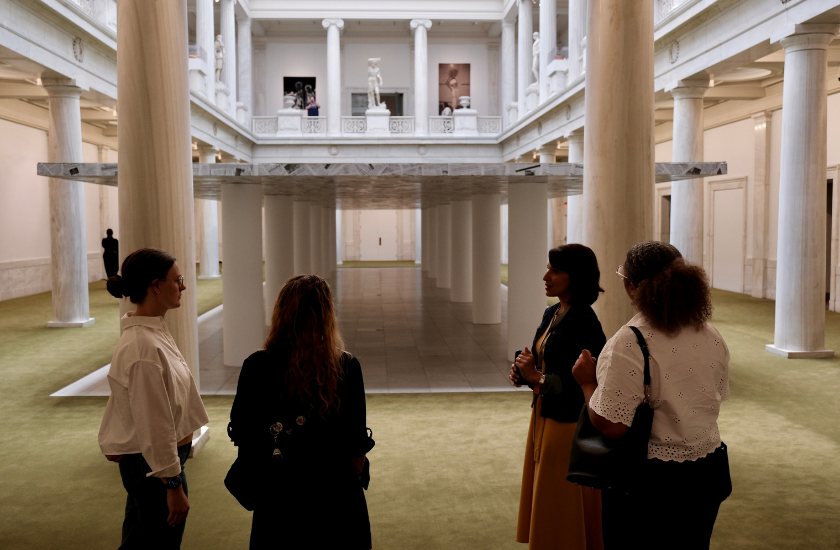
The 59th Carnegie International, titled "If the word we," opened the first weekend of May to more than 10,000 visitors, marking the highest opening weekend attendance in the exhibition's 130-year history. The title comes from the exhibition's central question: what "we" means, and who it includes. It's drawn global press coverage too, from more than 150 pieces to date.
This is something different.
Our full team was thrilled to tour the International together with Stefanie Cedro Mohr, Senior Director of Marketing and Communications at Carnegie Museums of Art and Natural History, who generously led us through the galleries and added context we couldn't have gotten on our own. Afterward, each of us chose one piece that personally resonated. Not necessarily our favorites but the works that spoke to us, unsettled us, or stuck with us longer than we expected.
Here's what stayed with us.
Silät, “Tewok: the river we weave”
Chosen by Communications Coordinator Kyrie Bushaw
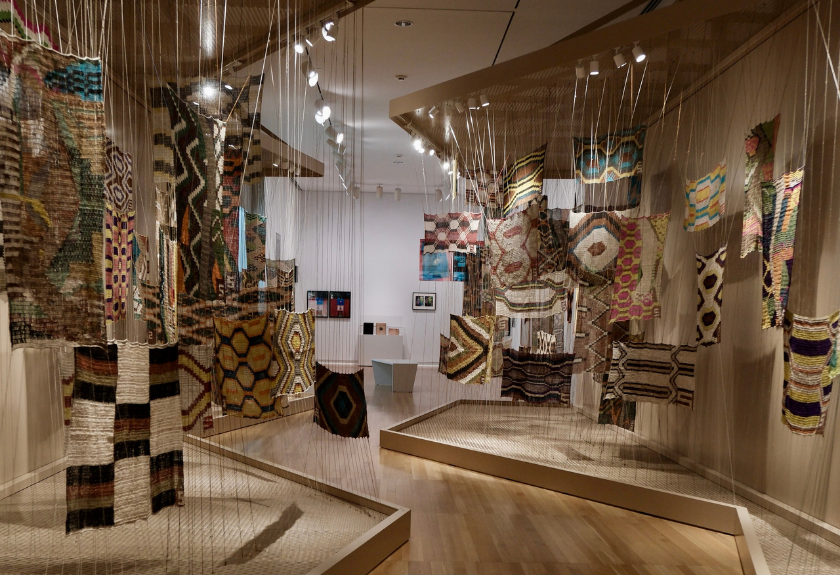
The work that stood out to me most was “Tewok: the river we weave” by Silät, a collective of over 100 women weavers from Santa Victoria Este, an Argentine town located near the borders of Bolivia and Paraguay. Led by Claudia Alarcón and curator Andrei Fernández, who has been working in Wichí territory since 2015, the installation borrows its title from the Wichi name for the Pilcomayo, a river that begins in the Bolivian Andes and winds back and forth across Paraguay's and Argentina's shared border.
In the installation, each weaving represents one member of the collective and each piece is made from hand-spun fibers of the chaguar plant, dyed with natural pigments, and shaped by hands guided through generations of craftspeople, often women. The forms and motifs that appear in each member's work are connected to what they know, remember, and wish to share about the river, while their collective work creates a forest of weavings, inspired by the ways in which trees grow.
I find work like this deeply moving. So much of what fills art museums is either aggressively modern, often creating a barrier for connecting, or very old work made for the wealthy and powerful. Craft is different. It is familiar yet singular, every iteration shaped by the specific hands, lives, and communities that developed and created it. It is art created by everyday people often for those they love. That intimacy makes it easy to believe what I think is actually true: living with art is our birthright, it belongs to everyone, it is how we belong to each other, and it will continue to fly from our fingertips as long as we are willing to sit, show, and learn with each other.
Natasha Tontey, “Garden Amidst the Flame”
Chosen by COO Mia Hooper
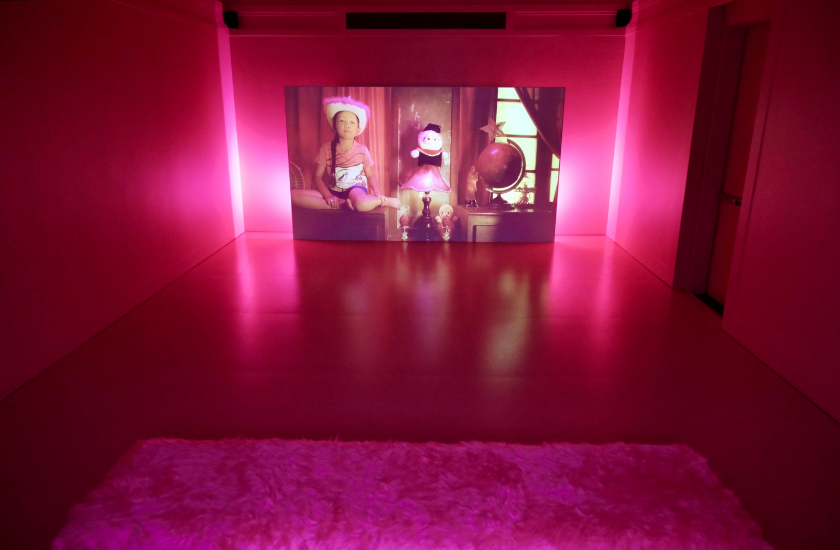
When you step into the room in the Carnegie Museum of Art that contains Natasha Tontey's "Garden Amidst the Flame," you're surrounded by pink in every direction: saturated pink light, fuzzy pink fabric draped over the viewing bench. It feels like an explosion of girlhood. On screen, a film plays on a loop, so you enter mid-story and let it pull you in wherever it is.
Tontey, who was born on the Minahasan Peninsula in Indonesia and now lives in Jakarta and Yogyakarta, draws on the myths and coming-of-age rituals of the Minahasa, an Indigenous nation in North Sulawesi. The 27-minute film follows a group of young girls, beginning with the protagonist shaving her eyebrows. Her sister warns that doing so may give her the ability to see ghosts. It does! What follows is a journey through a dreamlike spirit realm.
I'll be honest: the eyebrow shaving scene made me say out loud, “Oh no! They won’t grow back the same ever!” It reminded me of my friends who overplucked their own in their teenage years and now must live with limited brow hairs. I also laughed when I first saw a figure I thought was a monster, then later learned was a Minahasan mythological being. The moment it appeared on screen, it reminded me of Old Gregg, a seaweed-draped merman with smeared red lipstick from "The Mighty Boosh," a show from the earlier YouTube days.
There was something about sitting in a pink room, watching a film rooted in traditions from the other side of the world, and suddenly being hit with a wave of my own nostalgia. Through this piece, Tontey is exploring important questions of gender, tradition, and how cultures carry their stories forward. But I think there's also something cool about a film built on coming-of-age memories unlocking one of mine.
Camara Taylor, “Untitled (Falls of Clyde, 1492, 1707- )”
Chosen by CEO Patrick Fisher
During our tour, I initially thought I would write about Zhao Yao's “A Few Ordinary Parallel Lines.” I'm often drawn to artistic processes, and I found myself fascinated by the materials Yao used, and wanted to understand more about how one cracks and peels an egg to create such perfect lines from eggshells. But when I later reviewed materials from the exhibition and looked back through the photographs I had taken, I found myself returning instead to Camara Taylor's “Untitled (Falls of Clyde, 1492, 1707- ).”
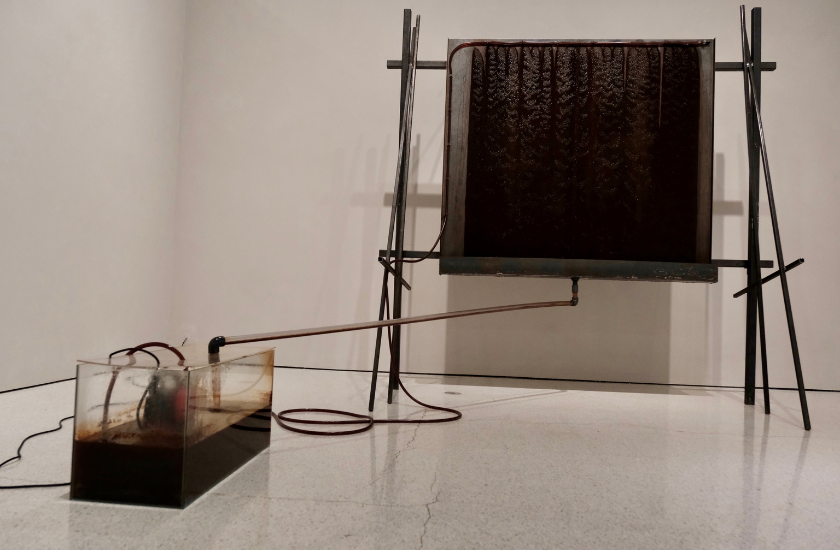
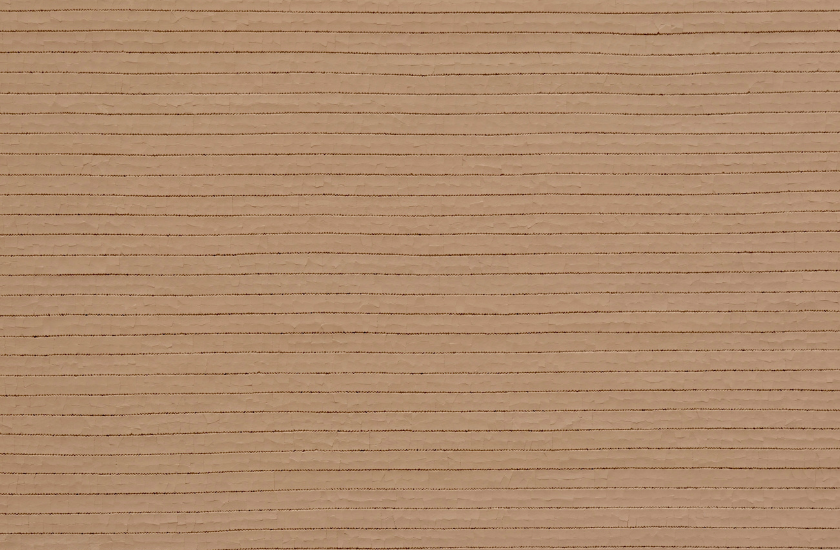
The installation consists of a sheet of steel, glass tanks, plastic tubing, and dark Caribbean rum that continuously circulates through the work. As the rum flows over the steel, it slowly transforms the surface, leaving behind rust and sugar deposits that accumulate over the course of the exhibition. Born in London and now based in Glasgow, Scotland, Taylor references Glasgow's historical relationship to the Caribbean sugar trade and the wealth generated through the labor of enslaved people, while also drawing connections to the River Clyde, an industrial waterway that helped fuel Scotland's economic growth. The dates in the title point to the beginnings of European colonization in the Americas and the political formation of Great Britain, situating the work within a much longer history of empire, extraction, and trade.
I appreciate work that invites us to see a new perspective, but I'm equally interested in work that pushes against conventional ideas of form, material, and permanence. Taylor's installation does both. Rather than presenting a fixed object for contemplation, it creates a continuous process that unfolds over time.
I found myself thinking about how the piece will continue to evolve throughout the duration of the Carnegie International. The rum continues to flow. The steel continues to corrode. The surface bears the cumulative effects of what has passed through it. The work itself becomes a record of change, carrying forward the traces of its own history while asking us to consider the ways histories continue to shape the present.
I've spent the last 10 years working in a field that is grappling with questions of legacy, how past decisions continue to shape the opportunities, inequities, resources, and challenges we experience today. Taylor's work reminded me that history is not something we leave behind. It accumulates. It leaves residue. It alters the structures it touches, whether we acknowledge it or not.
Ana Raylander Mártis dos Anjos, “Justiça (2026)”
Chosen by Director of Marketing and Communications Lisa Cunningham
When we turned a corner and came face-to-face with Canadian artist Walter Scott's "EURO TRASH GIRL" — a wide-eyed figure dressed all in black with stringy blond hair, hands suction-cupped to the glass, mouth open like she's screaming and trying to escape — it was like looking in a mirror. (Since my Instagram handle is @trashyleesuh, my PGH TRASH GIRL Halloween costume is settled!)
But the piece I keep thinking about is Brazilian artist Ana Raylander Mártis dos Anjos’ “Justiça (2026)” in the Heinz Architectural Center. When I walked into the connecting hallway and looked up, my first thought was that the ceiling was dirty, like dead bugs trapped in a long-neglected bathroom ceiling fan cover. Then I looked closer.
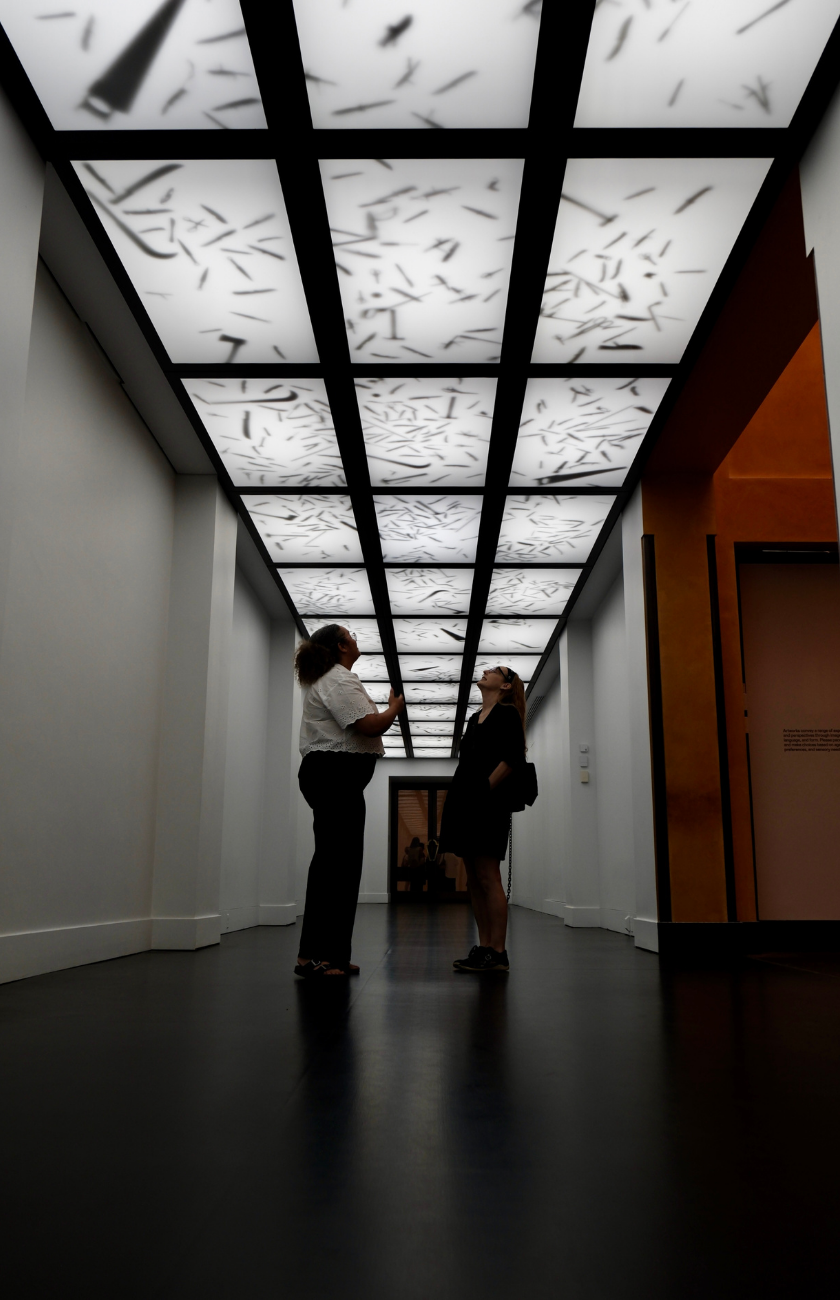
The silhouettes scattered across the overhead light panels are weapons. Three thousand of them, collected in the United States through both legal and illegal means. Mártis dos Anjos calls them "white weapons": everyday objects like saws and screwdrivers that can harm someone, depending on whose hands they're in. At each entrance to the gallery, heavy chains hang from the walls as if passing straight through the building.
What struck me in this installation is that each of the overhead objects could be a tool or a weapon, but together they form a pattern running the length of the hallway, one I found myself admiring the way I admire patternwork an artist builds intentionally into a piece. The chains cause moments of interruption that kept reminding me to look back up and take a closer look. Fixating on any single object is unnerving. Taken as a whole, they tell a story.
As true crime and crime drama fanatics, Mia Hooper and I both immediately started talking about “Dexter,” episodes of “Dateline,” “Law & Order,” and serial killer documentaries. My mind kept racing: Did someone held captive break free of the chains and leave a trail of weapons behind them on their way to revenge? Are the chains waiting for someone, the objects overhead the evidence of their crime as they're hunted down? Or is someone chained on the other side of the wall right now, unseen by us?
I couldn’t stop thinking about this piece long after I left the exhibition, and eventually had to look up whatever I could find on the artist's intent. What I found made me appreciate the piece even more. In Brazil, objects like the “white weapons” suspended in the ceiling are confiscated by police and sometimes planted at crime scenes, deepening injustice for people already marginalized by the state. Mártis dos Anjos argues this isn't a Brazilian phenomenon but “something structural in the application of justice as we understand it within our worldview.”
I already know I’ll be remembering this piece the next time I binge-watch true crime documentaries, questioning what “we” means and who it includes whenever evidence appears on screen.
These four works are just our answers. Let us know what sticks with you when you visit. We'd love to hear your choices. If you post a photo on Instagram, tag us and we’ll share it to our stories!
If the word we: 59th Carnegie International, which continues through January 2027, also fills not only Oakland’s Carnegie Museum of Art, but includes four partner organizations. Learn more at carnegieart.org.