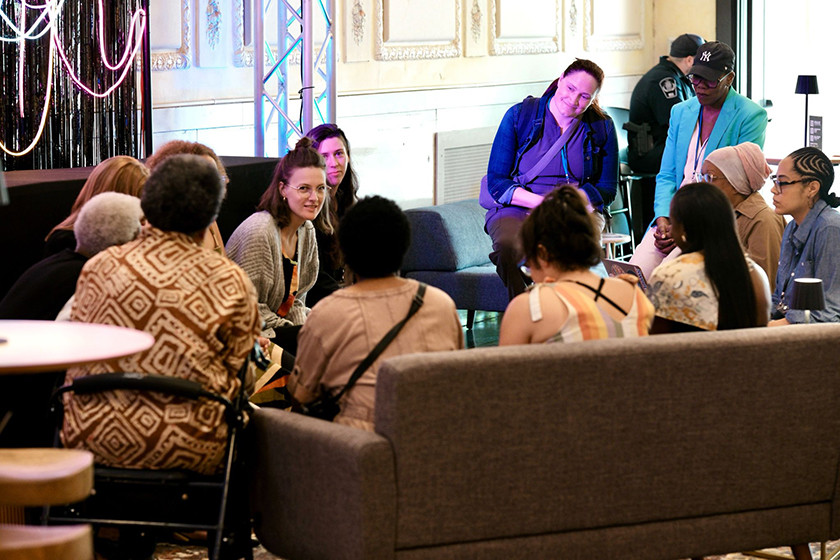
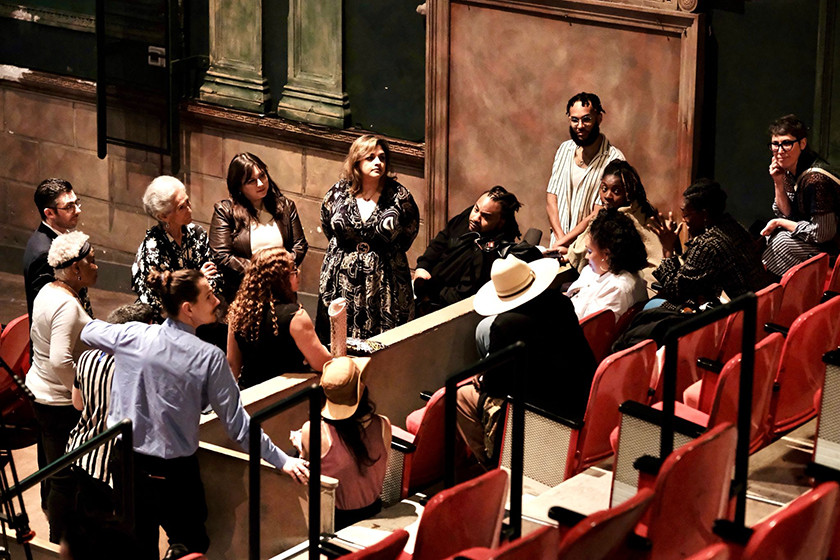
Attendees imagine a future Pittsburgh in a breakout session during a May 2025 keynote by cultural strategist Lisa Yancey at the Kelly Strayhorn Theater // Photo by Patrick Fisher
The City of Pittsburgh stands at a crossroads. After more than a year of work, tens of thousands of resident interactions, and the completion of expected deliverables, City Council is now considering halting Pittsburgh 2050, the city’s first truly comprehensive planning process in over a decade. The justification? That the work is “too expensive.”
But cancelling the plan now, with so much work already complete, is not fiscal responsibility. It is a costly retreat that throws away public trust, millions already invested, and the rare momentum of a citywide visioning effort that has finally begun to feel real.
PGH 2050 was launched because the city needed a roadmap, one shaped by its people, aligned with national best practices, and grounded in careful, data-driven planning. For years, Pittsburgh has struggled with fragmented development decisions, uneven growth, and persistent inequities across neighborhoods. The plan was designed to bring coherence to these challenges and ensure that residents, not political shifts or piecemeal policymaking, set the direction for the city’s next era.
Residents from every corner of Pittsburgh have shared their hopes for safer streets, more affordable housing, climate resilience, economic opportunity, better governance, and a city where every neighborhood has a fair chance to thrive.
Most remarkable is how deeply this process has invited community participation. Residents from every corner of Pittsburgh — long-timers, newcomers, elders, youth, small business owners, artists, neighborhood advocates, nonprofit leaders — have shown up. They’ve shared their hopes for safer streets, more affordable housing, climate resilience, economic opportunity, better governance, and a city where every neighborhood has a fair chance to thrive.
This type of engagement does not happen by accident. It happens because the City invested in external practitioners who know how to build authentic relationships, who understand Pittsburgh’s unique landscape, and who bring national knowledge of what has worked elsewhere, and what hasn’t. PGH 2050 is not a template imported from outside. It’s a custom, locally grounded process supported by experts who help ensure community voices lead the way.
Some members of City Council now argue that the work should be brought “in-house,” despite the fact that the City does not currently have the staff capacity, technical expertise, or time to manage a project of this scope. City departments are already strained with daily operations, overlapping priorities, and essential services that require constant attention. Comprehensive engagement, real engagement, requires far more than simply posting surveys or hosting a handful of meetings. It requires deliberate design, coordination across agencies, deep listening, and extensive follow-through.
Attendees imagine a future Pittsburgh in a breakout session during a May 2025 keynote by cultural strategist Lisa Yancey at the Kelly Strayhorn Theater // Photo by Patrick Fisher
We know this because Pittsburgh has tried the alternative. The last comprehensive planning effort, produced internally in 2014, never truly materialized; its components languished, under-resourced and largely unknown. Without dedicated, contract-bound professionals whose sole job is to carry the work forward, ambitious planning collapses under the cumulative weight of daily government demands.
The suggestion that halting the current contracts will save money ignores the reality that millions in public investment, and the value of residents’ time, have already been committed. Walking away now squanders both, especially when obligations have been met and results are on track. Yet that is exactly what is being proposed.
Even more troubling is the message such a reversal would send to Pittsburghers. For the past year, residents have shown up in good faith, believing that their input matters and that the City is finally building a transparent, participatory structure for long-term decision-making. If Council cancels the plan now, it signals that even when Pittsburghers do everything expected of them, attend meetings, share ideas, collaborate with neighbors, their voices can still be brushed aside the moment political winds shift.
This is not simply about planning documents. It is about civic trust. It is about whether Pittsburgh sees itself as a city capable of long-term thinking or one condemned to repeat the cycle of starting, stopping, and stumbling.
Visionary, inclusive planning is indeed expensive. But the costs of not planning, or of planning poorly, are far greater.
Visionary, inclusive planning is indeed expensive. But the costs of not planning, or of planning poorly, are far greater. Cities that thrive are cities that anticipate change, build resilience, and center equity. PGH 2050 is the tool that allows us to do that. Abandoning it now would leave us without the information, structure, and shared purpose necessary to guide decisions on development, climate, mobility, housing, economic growth, and neighborhood investment for years to come.
During a November 24 meeting, members of Pittsburgh City Council voted to table further discussion until early December, giving members time to review the full scope of work before making a final decision. That breathing room is important, but I hope it was used wisely. Pittsburgh does not need more delays, more reversals, or more missed opportunities. It needs courage. It needs consistency. It needs a commitment to finish what we have started.
The future of Pittsburgh depends on the choices we make today. Council should vote to continue the work of PGH 2050, not because it is easy or inexpensive, but because our city deserves a plan worthy of its people.
During the November 24 Pittsburgh City Council meeting, a Resolution was presented to terminate the comprehensive plan contracts. At that meeting, Council members voted to delay a decision on whether to continue or end Pittsburgh 2050 for two weeks. They also agreed to table further discussion until Tuesday, December 4, to give Director of City Planning Jamil Bey time to present his findings — including the expenses needed to complete the plan — to a small group of Council members before sharing those findings and recommendations with the full Council.