
Guest Blog |
The Over-Policing of a Creative Culture
This first-person essay is part of a series on arts and public policy, published ahead of the Greater Pittsburgh Arts Council’s Policy and Action Roundtable on March 5.
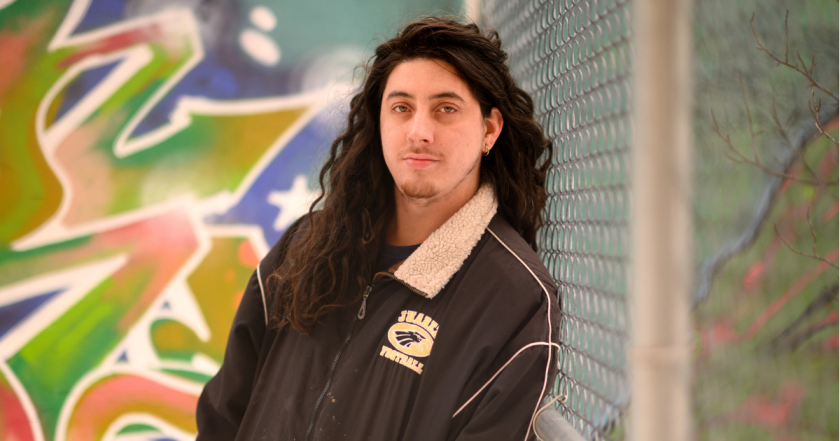
Fortunately and unfortunately, I’ve seen and lived all sides of Pittsburgh’s graffiti policy as “Pittsburgh’s Most Wanted” graffiti writer in 2016, and as one of the city’s most celebrated spray can artists in 2026.
I have seen regular praise for murals and street art, but while public sentiment has begun to open up to graffiti as an art form, the city’s policing and policies have shown no comparable leniency.
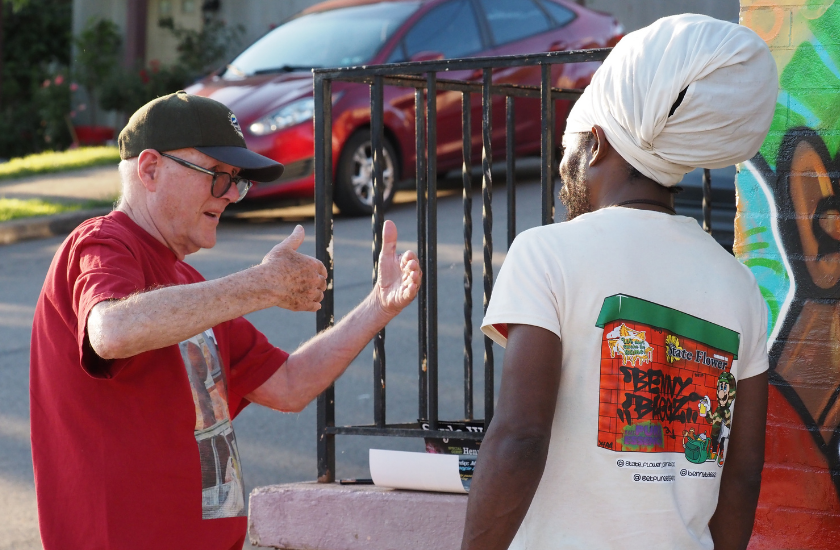
Over the past decade, I have become a regular guest educator for Winchester Thurston School and the Carnegie Libraries of Pittsburgh. I have created dozens of murals with PPS students and have run countless public spray can art workshops and graffiti summer camps. Along with Hemispheric Conversations: Urban Art Project, we brought spray can artists from Spanish-speaking communities and countries to Pittsburgh to paint, lecture, and exhibit their work. Through HCUAP, we also brought world-renowned documentarian Henry Chalfant back to Pittsburgh to show his 1983 film, Style Wars, at the Carnegie Museum of Art, which eventually led to a proclamation of a Henry Chalfant Day by Councilman Khari Mosley. I helped establish the Clement Way Legal Graffiti Alley in Bloomfield with the Pittsburgh Autonomous Art Collective and have put on two graffiti festivals in South Side’s Color Park.
During all of this, I have been on probation.
If I had attempted this career as a full-time, professional graffiti artist even 10 years prior, the lack of public understanding and acceptance would have made this impossible. While some community members and institutions have begun to recognize the artistic and economic value of this work, local government has shown little willingness to reevaluate its approach to graffiti and spray can art. The result is a city known for some of the harshest graffiti sentencing practices in the United States, defined by stacked charges, multi-year prison terms, six-figure restitution, and probation conditions that extend far beyond any reasonable definition of public safety.
Pittsburgh’s enforcement framework was built over decades: anti-graffiti bills, a “graffiti busters” era, a database, a trust fund, rewards for apprehending writers, and city-code changes that escalated fines and pushed cases into felony territory. What that history produced is a sentencing culture that often stacks charges, leans on pressure tactics, and tries to make examples out of people. Yet, the graffiti persists.
I was one of those examples: over one year of house arrest, 54 charges of criminal mischief (with 12 of those being felonies), an undetermined length of probation, $58K in restitution (initially $114,030), and hundreds of hours of community service. And my sentencing wasn’t even the worst.
So what would I like to see change at a policy level?
First, community service and pre-trial diversion programs should be the default response, not jail, endless probation, or life-altering financial punishment. With this, the restitution calculations for criminal mischief need to be adjusted. As it currently stands, the initial act is charged as an M3 Misdemeanor. The city calculates additional charges at $50 a square foot, while on average my murals cost $15 a square foot. With this rate, a single piece of graffiti can easily become an M2 or an F3 Felony based on its size.
About the Author
Max Emiliano Gonzales, also known by their artist name “GEMS,” can be classified as an activist, art educator, muralist, graffiti writer, curator, and much more. Originally from the Southwest side of Chicago and raised in Latino communities, Max brings a unique perspective to Pittsburgh and their Garfield community.
Max was brought to Pittsburgh in 2012 to attend Carnegie Mellon University's Fine Art program on a full-ride Scholarship. By 2016, Max had graduated with honors, secured multiple positions with the university, and was arrested as Pittsburgh’s most wanted graffiti artist. Rather than let the notoriety of their graffiti identity dwindle, Max has gone on to develop a career from it as a practicing artist, muralist, curator, and art educator.
Max has presented as a guest artist, lectured, and run workshops at locations including The University of Pittsburgh, Carnegie Mellon University, Winchester Thurston High School, Pittsburgh CAPA, Propel Schools, The Carnegie Libraries, Youth Places, Assemble Pgh, and The Environmental Charter School. Max is also a member of Hemispheric Conversations Urban Art Project, the Uptown Arts Council, and the Maxo Vanka Educational Programming Committee.
Lately, Max has become most well known for their spray paint murals and community-driven mural events. As a full-time muralist, Max wishes to use their identity and vast knowledge of the arts to serve the public and brighten the walls of any community they may be invited into.
Policy and Action Roundtable
If you’re interested in learning more on how public art and policy shape our communities, join us for the Greater Pittsburgh Arts Council’s Policy and Action Roundtable on Thursday March 5 at Point Park University.
This convening will bring together artists, cultural workers, nonprofit leaders, and Pittsburgh Mayor Corey O’Connor and Allegheny County Executive Sara Innamorato for a discussion on shared priorities, policy barriers, and opportunities for collaboration that shape the future of Pittsburgh’s cultural ecosystem.
Policy and Action Roundtable. Thursday, March 5, 9-11:30 a.m. Point Park University Ballroom, 201 Wood St., Downtown. $15. Learn more and purchase tickets at pittsburghartscouncil.org/events/policy-and-action-roundtable.